



The power of catch-up retirement account contributions after 50

Guidance You Can Count On

Our Insights

  • #
    Back to Insights

QuickBooks Online can boost your profitability—if you take full advantage of some of its more effective tools.

We like QuickBooks Online for a lot of reasons. It’s designed for small business owners, not accountants, so its language and processes are understandable. It offers all the tools you need to manage your income and expenses. It provides tools for tracking inventory, creating projects, and running payroll. It generates reports. Plus, it’s highly customizable, so no matter what kind of business you own, you can make it work for you

QuickBooks Online’s bookkeeping capabilities can ensure that you get the numbers right, but its benefits go beyond that. Many of its tools can actually help you make changes to improve your company’s profitability if you commit to using them regularly. Try incorporating these five features into your regular workflow for three months and see how they can:

1. Improve Customer Relationships

Your customers are good, and it’s often well-worth your time to cultivate good, long-lasting relationships with them. If you haven’t seen their name on an invoice for a while, send them a friendly, personalized email offering a one-time discount. Or tell them about new products and/or services that they might like. And don’t neglect your best customers. Let them know occasionally that you appreciate their business by sending them a freebie.

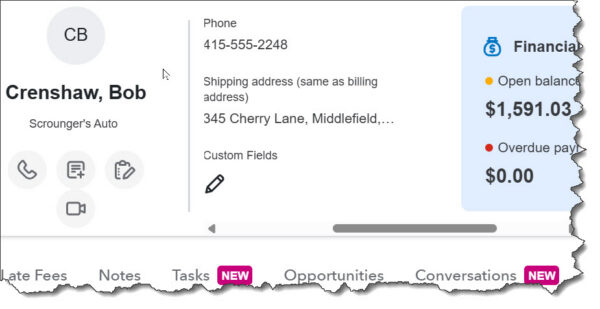
QuickBooks Online provides exceptionally detailed customer records that can give you quick insight into your customers’ history, their current status, and future opportunities. Beyond basic contact information, customer records offer comprehensive transaction lists and activity feeds that document your interaction with them. You can take notes and assign tasks, browse projects you’ve done for them, and see their current open balance and any missing payments. Connect Gmail or Outlook to QuickBooks Online, and you’ll be able to store conversations with them right in their records. You’ll find customer records by clicking the Home button in the toolbar, then Customer Hub, then Customers & Leads.

Sales by Customer

Maintain your customer records diligently, and QuickBooks Online can serve as a customer relationship manager (CRM). The Sales by Customer report can be a big help here.

2. Help Maintain Smart Inventory Levels

If you sell products, you know what a balancing act inventory management can be. Carry too much and you may be tying up more money than you need to. Cut your levels too close, and you risk not being able to fulfill some orders – and maybe even losing customers.

QuickBooks Online can help you track your inventory so you can minimize those problems. You’ll know instantly when you go to the inventory home page which stock levels are low, what your best sellers are, and whether there are any open sales orders or purchase orders. Inventory records provide details about each item. They also tell you what the quantity on hand is and whether any are on purchase order or sales order, as well as the reorder point that you set. Reports that are helpful here include Inventory Valuation Summary/Detail and Sales by Product/Service Summary and Detail.

To see inventory pages in QuickBooks Online, click All apps in the toolbar, then Inventory.

3. Accelerate Customer Payments

This is probably the most formidable problem that small businesses face. How do you get your customers to pay on time? You can, for example:

  • Charge late fees.
  • Decrease the number of days until the due date.
  • Offer a small discount for early payment.

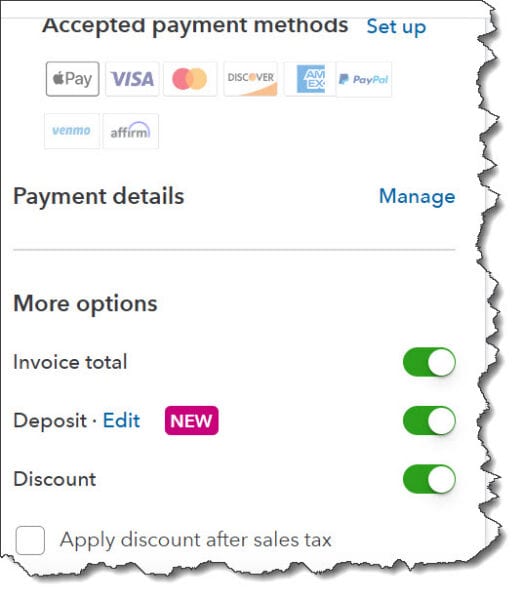
Probably the best way to encourage timely remittances is to allow customers to pay electronically. You’ll need to set up a merchant account through QuickBooks Payments. Customers will be able to pay directly through an invoice, on site or in a store, or digitally (ACH and credit/debit cards, Apple Pay, PayPal, Venmo, etc.). Transaction fees will apply.

Payment methods

You can speed up payments by giving customers more convenient, faster options.

4. Improve Your Cash Flow

It all comes down to how much is coming in vs how much is going out. Keeping a close watch on your cash flow is critical. Positive cash flow is not the same thing as profitability, but the two are, of course, closely related. QuickBooks Online provides ways for you to monitor this. Click the Home button in the toolbar and scroll down until you see the Cash Flow graph. This will give you a quick look at todays and your historical cash flow. If this snapshot doesn’t mean anything to you (and it may not; it’s pretty simple), we can analyze your situation by running and analyzing QuickBooks Online’s report, Statement of Cash Flows.

5. Keep Track of Your Digital Paperwork

How do you keep track of what invoices have been paid? You can always run a report that you should be running regularly: Accounts Receivable Aging Summary. This will spell out who owes you money and who is late sending it in. Though you can customize this report, the default view will show you a list of customers’ (and related jobs’) names with six additional columns showing whether they’re up to date or a certain number of days (by range) late: Current, 1-30, 31-60, 61-90, 91 and over, and Total.

You can also see a visual of your outstanding customer payments. Click Home, then Sales & Get Paid, then Sales transactions. Colored bars at the top of this page show you how much money is tied up in Estimates, Unbilled income, Overdue invoices, Open invoices and credits, and Recently paid. Click on any bar to see a list of related transactions below.

Final Thoughts

QuickBooks Online can, in many small ways, help you achieve profitability, but it takes diligence on your part. If you’re not already taking these five steps regularly, try to work them into your accounting workflow. Taken together, along with the other things you do to get profitable and stay profitable, you should see your smart use of QuickBooks Online pay off. If you have questions, please reach out to our QuickBooks team to learn more.

Reminder

Don’t forget that QuickBooks Desktop will be sunsetting in May of 2027, making now an important time to switch over to QuickBooks Online if you haven’t already. Please reach out to us to schedule a consultation to learn more.
 

Sign Up for our Monthly QuickBooks Newsletter

Get the latest updates delivered straight to your inbox!

Are you age 50 or older? You’ve earned the right to supercharge your retirement savings with extra “catch-up” contributions to your tax-favored retirement account(s). And these contributions are more valuable than you may think.

IRA contribution amounts

For 2025, eligible taxpayers can make contributions to a traditional or Roth IRA of up to the lesser of $7,000 or 100% of earned income. They can also make extra catch-up contributions of up to $1,000 annually to a traditional or Roth IRA. If you’ll be 50 or older as of December 31, 2025, you can make a catch-up contribution for the 2025 tax year by April 15, 2026.

Extra deductible contributions to a traditional IRA create tax savings, but your deduction may be limited if you (or your spouse) are covered by a retirement plan at work and your income exceeds a certain amount.

Extra contributions to Roth IRAs don’t generate any upfront tax savings, but you can take federal-income-tax-free qualified withdrawals after age 59½. There are also income limits on Roth contributions.

Higher-income individuals can make extra nondeductible traditional IRA contributions and benefit from the tax-deferred earnings advantage.

Employer plan contribution amounts

For 2025, you can contribute up to $23,500 to an employer 401(k), 403(b) or 457 retirement plan. If you’re 50 or older and your plan allows it, you can contribute up to an additional $7,500 in 2025. Check with your human resources department to see how to sign up for extra contributions.

Contributions are subtracted from your taxable wages, so you effectively get a federal income tax deduction. You can use the tax savings to help pay for part of your extra catch-up contribution, or you can set the tax savings aside in a taxable retirement savings account to further increase your retirement wealth.

Examples of how catch-up contributions grow

How much can you accumulate? To see how powerful catch-up contributions can be, let’s run a few scenarios.

Example 1: Let’s say you’re age 50 and you contribute an extra $1,000 catch-up contribution to your IRA this year and then do the same for the following 15 years. Here’s how much extra you could have in your IRA by age 65 (rounded to the nearest $1,000):

  • 4% annual return: $22,000
  • 8% annual return: $30,000

Keep in mind that making larger deductible contributions to a traditional IRA can also lower your tax bill. Making additional contributions to a Roth IRA won’t, but they’ll allow you to take more tax-free withdrawals later in life.

Example 2: Assume you’ll turn age 50 next year. You contribute an extra $7,500 to your company plan in 2026. Then, you do the same for the next 15 years. Here’s how much more you could have in your 401(k), 403(b), or 457 plan account (rounded to the nearest $1,000):

  • 4% annual return: $164,000
  • 8% annual return: $227,000

Again, making larger contributions can also lower your tax bill.

Example 3: Finally, let’s say you’ll turn age 50 next year and you’re eligible to contribute an extra $1,000 to your IRA for 2026, plus you make an extra $7,500 contribution to your company plan. Then, you do the same for the next 15 years. Here’s how much extra you could have in the two accounts combined (rounded to the nearest $1,000):

  • 4% annual return: $186,000
  • 8% annual return: $258,000

The amounts add up quickly

As you can see, catch-up contributions are one of the simplest ways to boost your retirement wealth. If your spouse is eligible too, the impact can be even greater. Contact us using the form below if you have questions or want to see how this strategy fits into your retirement savings plan.

© 2025

Talk to an Expert

Get personalized guidance for your situation.

Recent Insights

Ready to Take the Next Step?

Our team is here to provide guidance you can count on.